
Friday, January 12, 2007

Wednesday, December 13, 2006
Fly Your Wishes to the Moon!
 As part of our Messages from Earth project, The Planetary Society, in conjunction with The Planetary Society of Japan and the Japan Aerospace Exploration Agency (JAXA), invites the world to participate in the "Wish Upon the Moon" campaign to send names and messages to Earth’s Moon on Japan's SELENE mission. Adults and children alike can submit names and brief good wishes for inclusion on the spacecraft. I will join this campaign.
http://planetary.org/programs/projects/messages/selene.html
Thursday, December 07, 2006
Karuta - Japnese card game -
 Karuta is a traditional card-matching game in Japan. A set consists of 2 types of cards-'Reading Cards' and 'Playing Cards'. The essential rule of game is as follows: A reciter reads the Reading Cards, and two or more players compete to be the first to touch the matching Playing Cards. The 100 poems for this game are taken from the anthology of Japanese traditional poetry.
 Beside that it is kind of traditional event in New year season, I define Karuta as "Sports" because it require quick motion and considerably high skill to be "professional". Among them, identifying and slapping the card is completed within one second immediatly after just one or two syllables are read.
Here, the picture above is the moment right woman has slapped the card and the card is flying.
Kappa - legendary creature -
 Kappa is one the most familiar mythcal creature in Japan. They are child-sized humanoids and look like frog. The most distinctive feature is that they have "dish" on their head and turtle's shell on their back. They inhabit rivers and are sometimes mischievous like kidnapping children into river. I think they used to play a roll to warn children to swim river without adults supervision.
 Kappa are not entirely antagonistic to mankind, however. They are curious of human civilization, and they can understand and speak Japanese. They may even befriend human beings in exchange for gifts and invite children to play Sumo with. Because Kappa likes cucumber, the sushi rolling up cucumber are called "Kappa roll".
"Kappa roll"


Nara - my hometown -
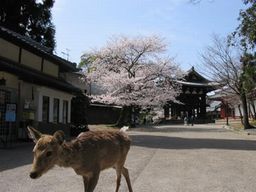 Nara, my hometown, is the ancient capital of Japan (i.e. 1500 years ago) located in south of Kyoto and east of Osaka which is the second largest city in Japan. The most interesting spot for tourlists would be Nara park that is home to hundreds of freely roaming deer. Deer, themselves officially protected as National Treasures and regarded as messengers of the gods by Shinto. Nara has three UNESCO World Heritage Sites such as Tōdai-ji temple. Tōdai-ji (東大寺), the Eastern Great Temple, is the largest wooden building in the world, and houses a giant statue of the Buddha.
Pencil board
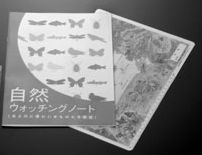 I want to introduce you about Shitajiki that are very common in Japan but I can't see these kind of things here. Shitajiki are pencil board or desk pad made of plastic pad. Typically, shitajiki are placed underneath the top sheet of a notebook to prevent marking on the sheets below and to provide a stiffer surface for writing. It's useful when you write on paper on the textured surface as well. Doesn't American care if writing are traced below the top sheet?
Shinto - Japanese religion -
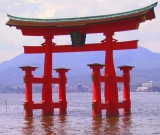 I didn't know that what Shinto exactly is and I found the reason. The key is Shinto has no dogma, no holy scripture but has a lot of gods. Though Shinto practices and teachings are not popular, Shinto beliefs and ways of thinking are deeply embedded in the subconscious fabric of Japanese.
"Shinto is a collection of rituals and practices have originated organically in Japan over a span of many centuries The most immediately striking theme in the Shinto religion is a great love and reverence for nature. Thus, a waterfall, the moon, or just an oddly shaped rock might come to be regarded as a kami (god). Post-war, the number of Japanese citizens identifying their religious beliefs as Shinto has declined a great deal, yet many practices have persisted as general cultural beliefs (such as ancestor worship, which is still very popular), superstitions, and community festivals.
Shinto has been influenced by Japan's contact with the religions of other nations, especially China. It is very difficult to untangle Shinto and Buddhist beliefs about the world. One might say that where Buddhism emphasizes the afterlife and ending the cycle of rebirths; Shinto emphasizes this life and finding happiness within it. Though Buddhism and Shinto have very different perspectives on the world, most Japanese do not see any challenge in reconciling these two very different religions, and practice both. Thus it is common for people to practice Shinto in life yet have a Buddhist funeral." (Wikipedia)
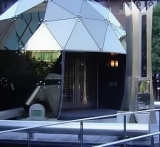 Shinto has adjusted to modern society throughout history, and I think adjustment is one of distinctive feature of Japanese personality.
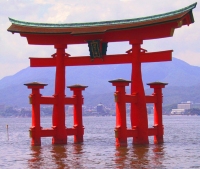
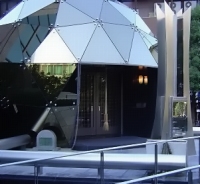
Pictures are traditional(above) and modern(below) shrines.
Subscribe to:
Posts (Atom)